Frequently asked Questions
Do I work for another company?
No. My husband and I research, formulate and produce our products by ourselves. We do not resell or copy. My husband’s beekeeping hobby and my passion for gardening have spurred us to learn more about nature and how we can use natural design to improve the quality and enjoyment of life for our family.
Do you teach or sell homeopathic remedies?
No. Homeopathy, an alternative medicine modality, is based on the idea that “like cures like.” The theory is that remedies formulated from substances that would normally cause symptoms in a healthy person would improve the condition of an ill person. These remedies are highly diluted many times over using the succussion technique. The dilution is usually then mixed into a sugar pill and bottled in a highly processed, manufacturing environment. Herbalism uses material doses, or food quantity doses, in order to shift physiological processes. Herbs can be eaten (if tasty!), made into teas or soups, or extracted and preserved for future uses.
What is Herbalism?
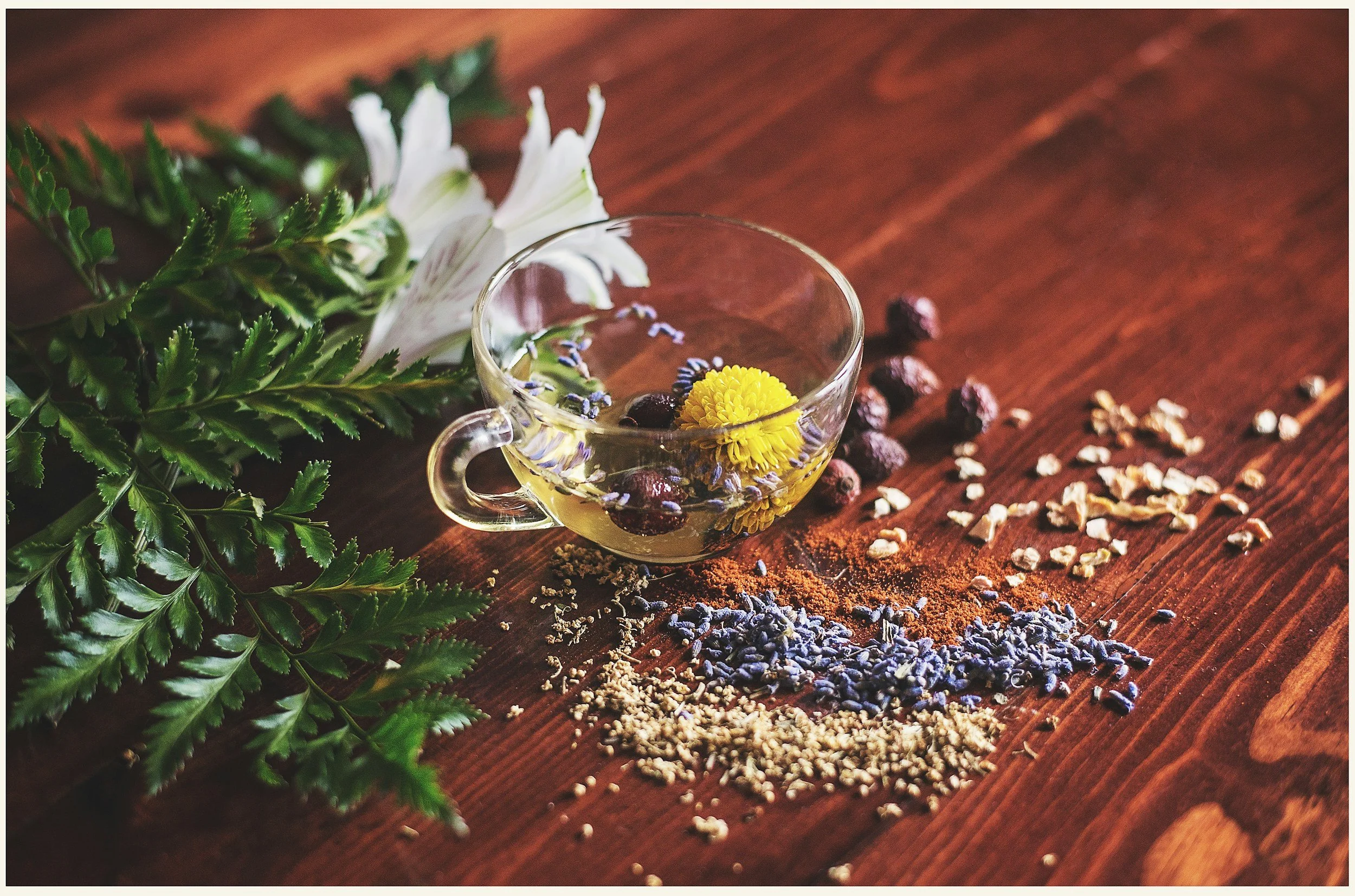
Herbalism is the use of the chemistry of whole plants to support health, just as you would eat whole foods during a meal to satiate hunger and provide nutrition for the body. Herbalism is as much about nutrition as it is about chemistry. Many of the plants we would consider medicinal in modern times used to be regularly consumed as food and are now considered supplements to take when we get sick. One of the goals of the herbalist is to show people that food is medicine, and medicine is food (Hippocrates was right). However, the key goal is to alleviate suffering. Alleviating suffering can sometimes be achieved simply by changing the diet, but quite often we turn to plants that are not consumed as food yet have a complex chemistry that effect change in body systems and therefore in health conditions.
Are you self-taught? What training do you have?
I am both formally trained and self-taught. While my learning in the field of herbalism did begin alone over a decade ago, it was with books, not the internet. That’s an important distinction to make in an age when we are now inundated with information every time we go online. I studied reliable academic textbooks authored by experienced clinical herbalists and holistically minded doctors. As far as formal training goes, I have a master’s degree in education which has equipped me well to be able to communicate information effectively to students as I prepare written materials and lectures. I completed a training certificate from the Herbalist School of Botanical Medicine with Dr. Patrick Jones and am currently working on another certification with the Eclectic School of Herbal Medicine in North Carolina with Thomas Easley. Ultimately my goal to is to become a registered herbalist (RH) with the American Herbalists Guild (you can read more about it here: https://americanherbalistsguild.com). I do not have a medical degree, nor do I practice medicine. I practice herbalism.
Are you selling essential oils?
No. While I do add essential oils to some of my products (i.e. soap and candles), they are included mostly for the benefit of avoiding artificial fragrances in personal care. An essential oil is only one part of a plant. Using whole plants in my extracts yields a more complex product (whose use is measured by the cup or spoonful) that also happens to be safer than essential oils, whose use must be measured in drops and almost always in dilution.